Every Sunday night, thousands of field service business owners are doing the same thing: manually piecing together routes for Monday's jobs. Moving pins on Google Maps. Shuffling spreadsheet rows. Texting technicians their stops at 10pm.
It costs them an average of 3.2 hours per week. At scale — 10 technicians, 50 daily jobs — that's a full-time job's worth of scheduling labor that produces routes that are, at best, 60% efficient.
AI route optimization changes the math entirely. Here's everything you need to know.
What is AI route optimization?
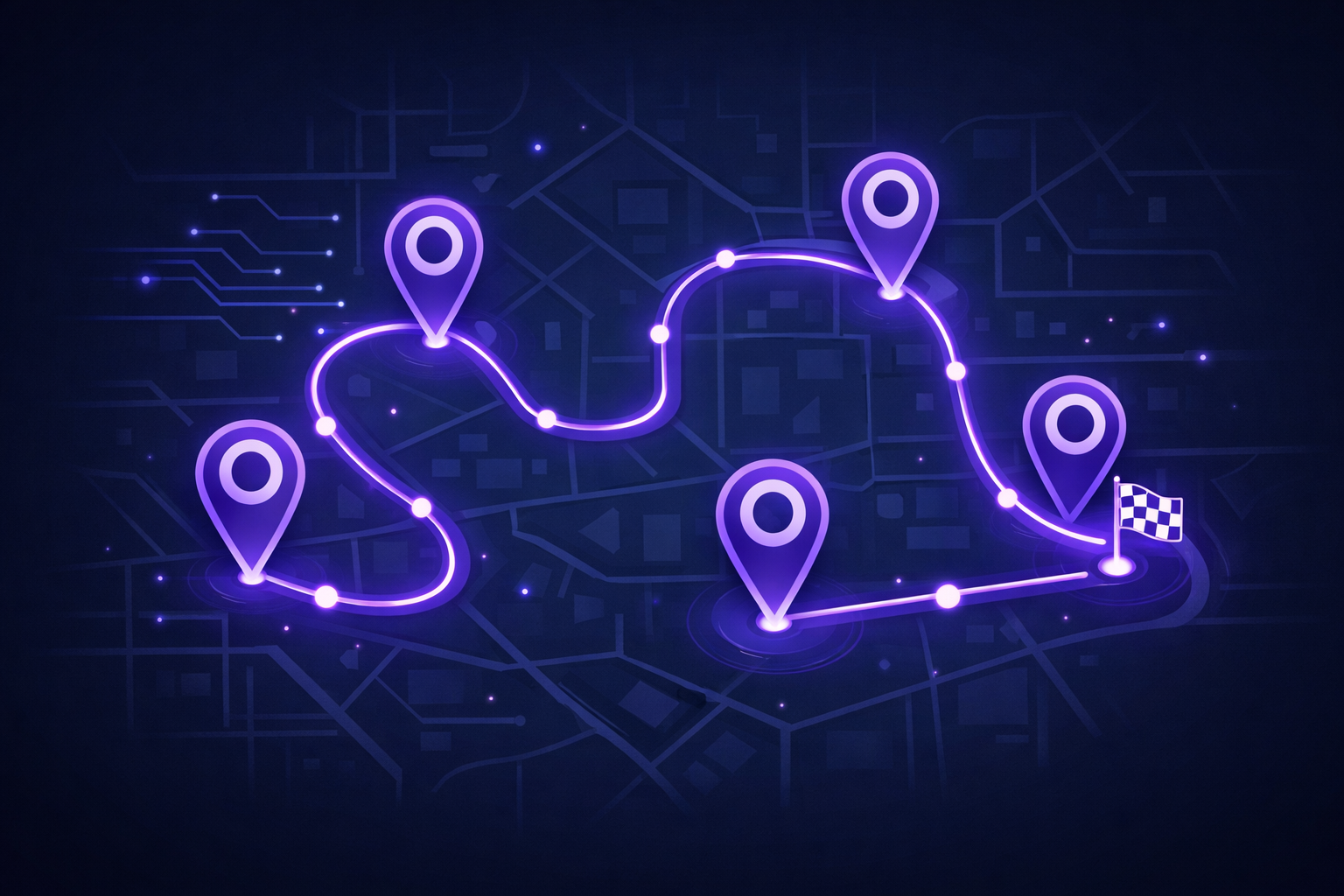
Route optimization is the process of finding the most efficient sequence of stops for a driver to complete a set of jobs. The problem sounds simple — it isn't. Mathematically, it's called the Traveling Salesman Problem, and even for 20 stops, the number of possible route combinations is astronomically large.
Human brains can't evaluate millions of combinations. AI can — in under a second.
Modern route optimization AI accounts for:
- Real-time traffic — not just distance, but actual drive time based on live conditions
- Job duration estimates — how long each stop actually takes based on historical data
- Technician start locations — routes that start from where your crew actually is
- Customer time windows — jobs that must happen at specific times slot into the sequence correctly
- Technician skills — routing jobs to the right person, not just the nearest person
- Vehicle capacity — for businesses that carry equipment or inventory
How much does bad routing actually cost you?
Most operators underestimate the cost of inefficient routing because the waste is invisible. It doesn't show up as a line item — it shows up as slightly lower margins, slightly higher fuel bills, and slightly burned-out technicians.
Here's a rough cost model for a 5-technician cleaning business:
- Each technician drives an average of 22 miles per job day
- With optimized routes, they drive 15 miles — 32% less
- At $0.67/mile (IRS 2026 rate), that's $4.69 saved per technician per day
- 5 technicians × 250 workdays = $5,860/year in fuel savings
- Plus 40 minutes/day recovered per technician = 1 extra job per day, per tech
For most operations, AI routing pays for itself in the first week.
What to look for in a route optimization tool
Not all route optimization software is equal. Here's what separates a real solution from a glorified Google Maps wrapper:
Multi-technician optimization
Basic tools optimize one route at a time. Real AI optimization solves all your routes simultaneously — balancing workload across your whole team, not just each person individually.
Dynamic re-routing
Jobs get added, cancelled, and changed throughout the day. Your routing system needs to update in real time without you manually rebuilding everything from scratch.
Historical learning
The best systems learn from your actual data — how long your crew really takes at each job type, which customers run long, which neighborhoods have parking issues. Routes get smarter over time.
Integration with scheduling
Route optimization without scheduling integration is half a solution. The jobs need to be in the system before routes can be optimized. Look for tools that do both.
How to implement route optimization in your business
The most common mistake operators make is trying to run the old system and the new system simultaneously. Pick a go-live date, commit to it, and don't look back.
Week 1: Get all your customer data and recurring job schedules into the new system. This is the hardest week — it gets much easier.
Week 2: Run the AI routes alongside your manual routes for a few days. You'll likely see the AI is routing more efficiently than you expected. Trust it.
Week 3: Full handoff. Let the AI run routes every morning. Your job becomes reviewing and approving, not building.
Month 2+: The system has now learned your business patterns. Routes get sharper. Fuel bills drop. Crew morale improves because nobody is driving across town unnecessarily.
The bottom line
Route optimization is not a nice-to-have for field service businesses — it's table stakes for any operation trying to grow past $300K annual revenue. The difference between manual routing and AI routing compounds every single day: more jobs completed, lower fuel costs, less crew burnout, and faster growth.
The businesses that move fastest are the ones that stop doing manually what a computer can do in seconds.